Tag: CALCUTTA

  • Calcutta- Looking Through The Eyes Of William Hodges

    Calcutta- Looking Through The Eyes Of William Hodges

    The role of art, photographs, and stories has contributed immensely to building travel narratives of Calcutta. Such travelogues emerged as an effort to familiarise unknown territories to the people of another nation. In the process, these narratives helped in initial mapping through explorers, artists, and travellers sharing geographical and ethnographic conditions that were observed. Exhibitions of these pieces attracted sizable crowds of people who were prepared to pay to see paintings portraying the people, cities, landscapes, and cultures of the colonised lands.

    Between the 16th and 18th centuries, 44 travelogues were published specifically on India and were available in European markets. These narratives were soon made available by the Asiatic Society of Bengal, which was established in 1784. This was directly supported by Warren Hastings and headed by William Jones.

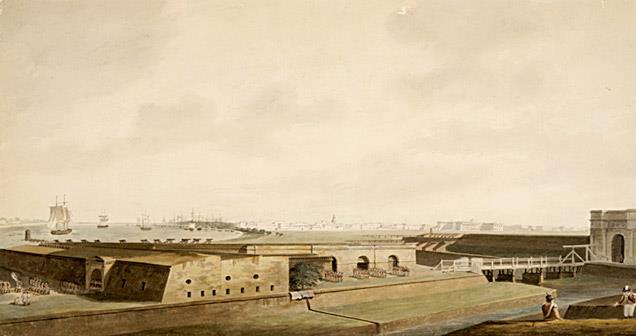
    While these narratives shared a European perspective of what India and, albeit Calcutta, looked like, visual representations close to reality were not available. During this period, while Warren Hastings was the Governor-general of India, landscape painter William Hodges came to Calcutta. Hodges first landed in Madras and later reached Calcutta in 1781 along the riverbank of Fort William. On his arrival, he was mesmerised by the sheer size of Fort William and found ‘Calcutta to be a spacious, well-planned city with palatial detached houses giving ‘the appearance of Grecian temples: and indeed every house may be considered a temple dedicated to hospitality.’

    Hodges, William; View of Calcutta; Manchester Art Gallery, Source: http://www.artuk.org/artworks/view-of-calcutta-205208

    William Hodges became a close friend of Warren Hastings and lived in Calcutta for three years, painting the city, especially the Banks of River Hooghly. In between, he also travelled extensively across India, with funds made available by Hastings. He also provided Hodges with an official post with a handsome salary of 12,000 rupees.

    As a landscape painter, Hodges created masterpieces which captured the serenity of the River Hooghly, the stillness of the dwellings, and the dynamism of the flora/fauna. His paintings rarely focused only on human figures, unlike earlier explorers and oriental artists painting human figurines and sceneries. Hodges’ collection of 90 drawings in three volumes became the main source for his oil paintings and prints of Indian subjects throughout his life. After Hodges died in 1797, these volumes were acquired by Warren Hastings and are now in the Yale Center for British Art. Hastings was among the first people in Calcutta to commission an oil painting from Hodges.
  • A girl with her morning tea along River Hooghly

    A girl with her morning tea along River Hooghly

    Keyword: Hooghly, Tea, Heritage walk, Kolkata

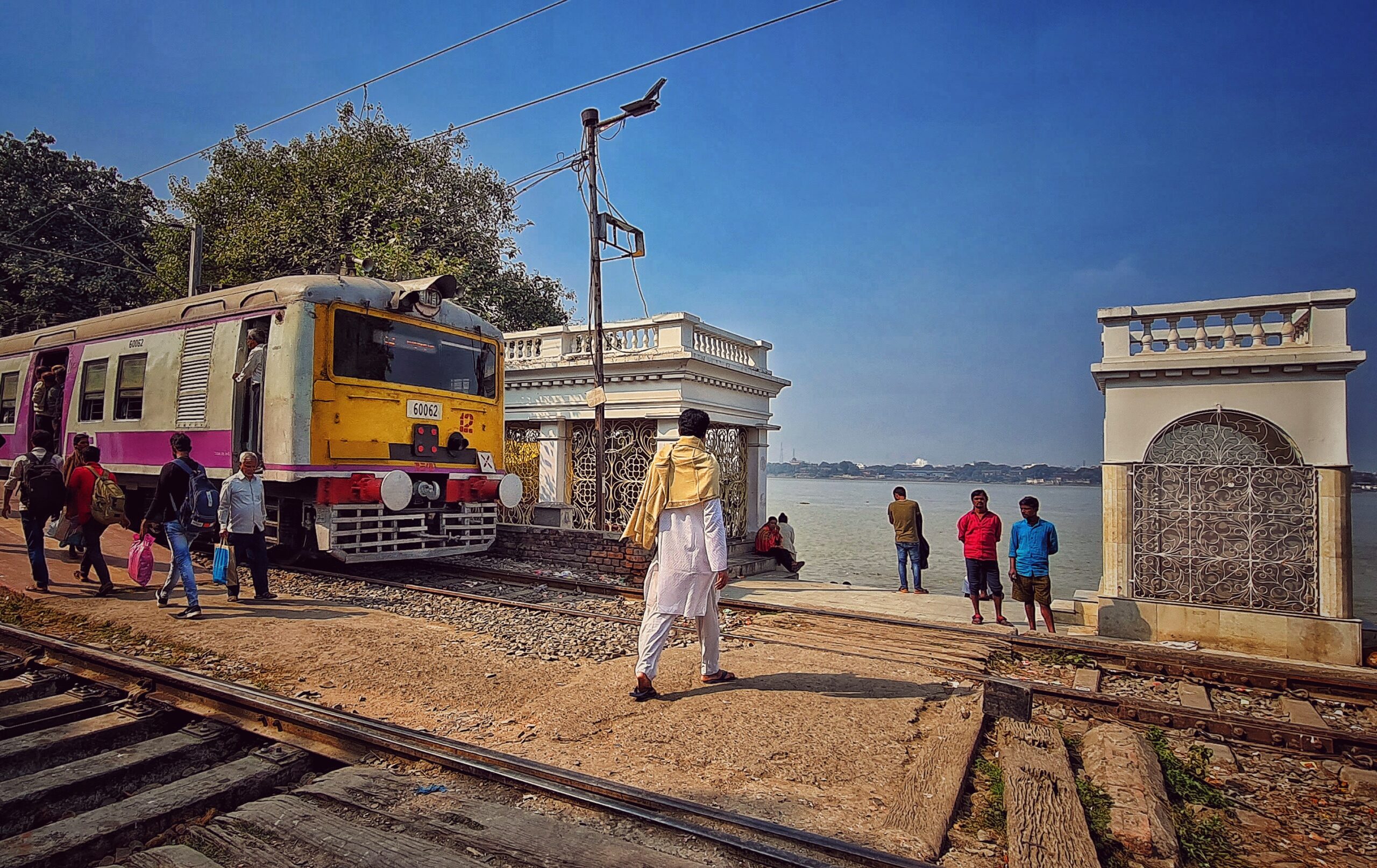
    In Kolkata, May is a hot and humid season. Scorching summer heat cannot allow one to forget the winter air that lightly breezes our face. The freshness of air ruffled hair. The chills in the air are a sign that hot tea needs to be ordered from the roadside kiosk or ‘chaer dokaan’ in Bengali. As my mind drifted away in the Kolkata winter, I could not help but share my early morning walking tryst along the River Hooghly.

    The winter had set in Bengal, and a cool whiff was in the air. Quickly, in an impromptu way, I decided to drive down to the riverbank and relish my morning tea or ‘cha’ by looking at the river. While the city may appear
    chaotic, its soul has not changed much, and one joy is having the ‘cha’.

    As I kept nearing the banks, I slowly rolled the windows down. The ‘City of Joy’ Kolkata from Calcutta has changed considerably. The poetic alleys, the rustic lanes with Art Deco and Neo-classical buildings or as we say, ‘bari’ has become older. These were almost entirely neglected in the newly created garbs of modernism.

    The riverbank is a melting pot with diverse activities. If one conducts diligent Cultural Mapping, it is far from a monologue. The complexity behind the distinctiveness of all activities is mind-boggling. It brings me to a reading from the British Library’s South Hampton to Calcutta’s publication. One of the narrations exuberates the deep connectedness of Calcutta’s people to Hooghly. It brings about a comparative narration of London and Thames, as is Calcutta and Hooghly. This book shares interesting first-count stories about festivals, rituals, daily activities, and many other activities immediately beside the bank.

    One such age-old tradition is the making of ‘bhaar’– the quintessential Bengali earthen clay tea cups. They are made from clay dug out of the riverbed and moulded by potters. The clay is given a delicate shape and baked thoroughly to render an earthy tone to the tea when sipped. Potters have maintained this craft for centuries and here I am sitting with my first cup of tea, sipping from the ‘bhaar’. I kept sipping the tea, looking at steamers transporting passengers across banks. There were early jobseekers soaking at the moment, and tea sellers earning the first trade. All while the city is slowly waking up to the hum-a-droll of the activities around it.

    An Early morning tea sojourn along the river bank

    An Early morning tea sojourn along the river bank. Source Author

Verified by MonsterInsights