Tag: bhagirathi

  • A girl with her morning tea along River Hooghly

    A girl with her morning tea along River Hooghly

    Keyword: Hooghly, Tea, Heritage walk, Kolkata

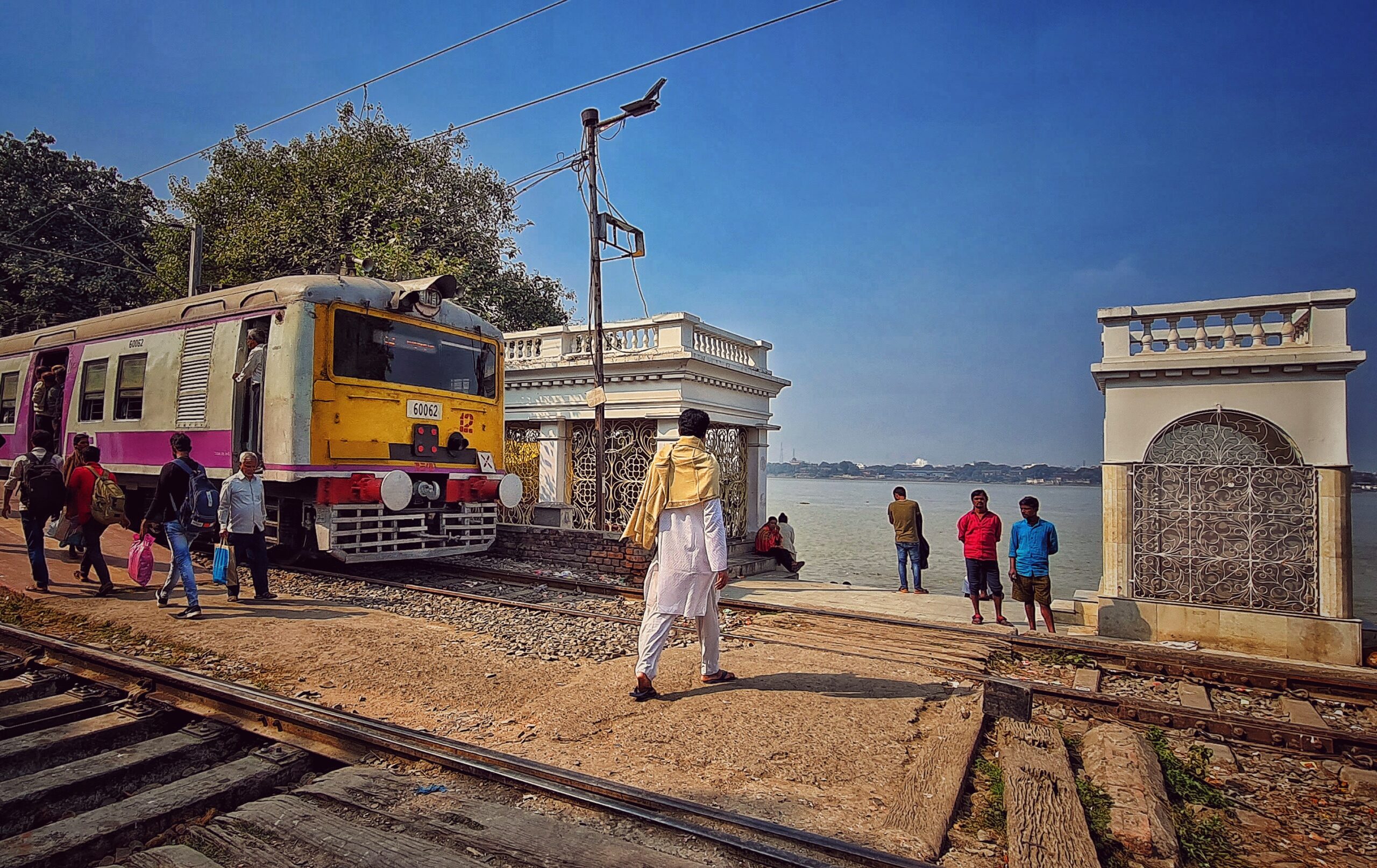
    In Kolkata, May is a hot and humid season. Scorching summer heat cannot allow one to forget the winter air that lightly breezes our face. The freshness of air ruffled hair. The chills in the air are a sign that hot tea needs to be ordered from the roadside kiosk or ‘chaer dokaan’ in Bengali. As my mind drifted away in the Kolkata winter, I could not help but share my early morning walking tryst along the River Hooghly.

    The winter had set in Bengal, and a cool whiff was in the air. Quickly, in an impromptu way, I decided to drive down to the riverbank and relish my morning tea or ‘cha’ by looking at the river. While the city may appear
    chaotic, its soul has not changed much, and one joy is having the ‘cha’.

    As I kept nearing the banks, I slowly rolled the windows down. The ‘City of Joy’ Kolkata from Calcutta has changed considerably. The poetic alleys, the rustic lanes with Art Deco and Neo-classical buildings or as we say, ‘bari’ has become older. These were almost entirely neglected in the newly created garbs of modernism.

    The riverbank is a melting pot with diverse activities. If one conducts diligent Cultural Mapping, it is far from a monologue. The complexity behind the distinctiveness of all activities is mind-boggling. It brings me to a reading from the British Library’s South Hampton to Calcutta’s publication. One of the narrations exuberates the deep connectedness of Calcutta’s people to Hooghly. It brings about a comparative narration of London and Thames, as is Calcutta and Hooghly. This book shares interesting first-count stories about festivals, rituals, daily activities, and many other activities immediately beside the bank.

    One such age-old tradition is the making of ‘bhaar’– the quintessential Bengali earthen clay tea cups. They are made from clay dug out of the riverbed and moulded by potters. The clay is given a delicate shape and baked thoroughly to render an earthy tone to the tea when sipped. Potters have maintained this craft for centuries and here I am sitting with my first cup of tea, sipping from the ‘bhaar’. I kept sipping the tea, looking at steamers transporting passengers across banks. There were early jobseekers soaking at the moment, and tea sellers earning the first trade. All while the city is slowly waking up to the hum-a-droll of the activities around it.

    An Early morning tea sojourn along the river bank

    An Early morning tea sojourn along the river bank. Source Author

  • The River Tales- Story of River Hooghly

    Kolkata, formerly known as Calcutta, is synonymous with the growth history of India. Once the capital of India, it almost set rules of how a growing metropolis with new Urban Planning and Urban Design laws could be. Geographically the city of Calcutta is located East of India along the banks of River Hooghly-Bhagirathi and was a major Trade centre. The imprints can still be seen today.

    River Hooghly, Calcutta by Johnston and Hoffmann, 1885 Source British Library Images

    The River Hooghly was notorious for high silting and often caused ships to get stuck at windings. Travels along the river for work were also getting perilous at a point in time when more Trade grew. The right analogy would be to say a ‘Traffic Jam’ on the river. One of the letters written by Mr Warren Hastings to his wife on August 1780 states that, though he has set sail, the ship is stopped by the wind, tide, and the winding of the river.

    Calcutta and its river banks were too important for driving World Trade by the East India Company; and cannot be deserted. Therefore, began a new approach to Improvement works. The city saw Improvement works to curb sanitation challenges, health challenges, water shortage, land ownership, walkability and many more. From the many, one of them was also ‘Improvement of the River Hooghly Navigation’.

    On 16th June 1865, Mr Leonard, the acting Superintending Engineer of the Public Works Department of Bengal, was appointed for a special task by the Under Secretary of State for India. He was instructed to prepare a report on improving the navigation along River Hooghly. The first report was prepared after extensive data collection from World Rivers. Their improvement works were studied before Mr Leonard could draw up his observations.

    He first travelled to Danube, and understood how silt could be removed at the entrance of the river. Then at Po he learnt documentation process for ground-deepening works. At Berlin he met engineers responsible for technical river works. Then at Danzig he learnt how to examine when a river is excavated, deepened, and connected to the Sea. He also went to the Rhine to understand types of machines that will help remove shoal and regulate the channel. Further on he went to Adour, and found a peculiar approach to river improvement. The ‘bar’ was removed from the river’s entrance. After that, Mr Leonard went to England and met master river engineers Clyde, Wear and Tees, whom he met personally.

    River Hooghly, Calcutta from the Elgin Collection ‘Spring Tours 1894-98’, 1890, Source British Library Images

    As a result of the learnings compiled, River Hooghly Improvement Works were initiated. It accounted for navigation, trade, fresh water supply to homes and networking with the Global Trade centres.

Verified by MonsterInsights