Blog

  • Calcutta- Looking Through The Eyes Of William Hodges

    Calcutta- Looking Through The Eyes Of William Hodges

    The role of art, photographs, and stories has contributed immensely to building travel narratives of Calcutta. Such travelogues emerged as an effort to familiarise unknown territories to the people of another nation. In the process, these narratives helped in initial mapping through explorers, artists, and travellers sharing geographical and ethnographic conditions that were observed. Exhibitions of these pieces attracted sizable crowds of people who were prepared to pay to see paintings portraying the people, cities, landscapes, and cultures of the colonised lands.

    Between the 16th and 18th centuries, 44 travelogues were published specifically on India and were available in European markets. These narratives were soon made available by the Asiatic Society of Bengal, which was established in 1784. This was directly supported by Warren Hastings and headed by William Jones.

    While these narratives shared a European perspective of what India and, albeit Calcutta, looked like, visual representations close to reality were not available. During this period, while Warren Hastings was the Governor-general of India, landscape painter William Hodges came to Calcutta. Hodges first landed in Madras and later reached Calcutta in 1781 along the riverbank of Fort William. On his arrival, he was mesmerised by the sheer size of Fort William and found ‘Calcutta to be a spacious, well-planned city with palatial detached houses giving ‘the appearance of Grecian temples: and indeed every house may be considered a temple dedicated to hospitality.’

    Hodges, William; View of Calcutta; Manchester Art Gallery, Source: http://www.artuk.org/artworks/view-of-calcutta-205208

    William Hodges became a close friend of Warren Hastings and lived in Calcutta for three years, painting the city, especially the Banks of River Hooghly. In between, he also travelled extensively across India, with funds made available by Hastings. He also provided Hodges with an official post with a handsome salary of 12,000 rupees.

    As a landscape painter, Hodges created masterpieces which captured the serenity of the River Hooghly, the stillness of the dwellings, and the dynamism of the flora/fauna. His paintings rarely focused only on human figures, unlike earlier explorers and oriental artists painting human figurines and sceneries. Hodges’ collection of 90 drawings in three volumes became the main source for his oil paintings and prints of Indian subjects throughout his life. After Hodges died in 1797, these volumes were acquired by Warren Hastings and are now in the Yale Center for British Art. Hastings was among the first people in Calcutta to commission an oil painting from Hodges.
  • A Walk to Rediscover the Dying Ghats of Kolkata

    A Walk to Rediscover the Dying Ghats of Kolkata

    Another day and another walk along the banks of River Hooghly.

    I was fortunate to join two young ladies of “The Ganges Walk”. The walk was to Rediscover the Dying Ghats of Kolkata this time. The walk began in the early morning. It was the end of 2022. The morning breeze was cold and fresh to walk the winding lanes and the bustling localities of Kolkata.

    With the team of The Ganges Walk and other heritage enthusiasts at the Chotulal Ghat, Source: Author

    Over the years, many well-established businessmen and administrators built structures along the banks, commonly known as Ghats. Ghats mean flight of steps leading to the River. Kolkata saw a flurry of Ghats dedicated to the city’s people. These Ghats represents diverse architectural styles like Islamic, Art Deco, Noe-classical and Colonial. Trade and transportation were permitted in selective Ghats to ensure better traffic management. While, bathing, praying, and cultural fiestas were permitted largely on all the Ghats. 

    Image from the Elgin Collection- Spring tours 1894-98 clicked by Bourne and Shepherd showing ghats used for performing rituals, bathing and as landing place of boats carrying people and goods from other destinations. Source: British Library Online Images. Source: British Library online images

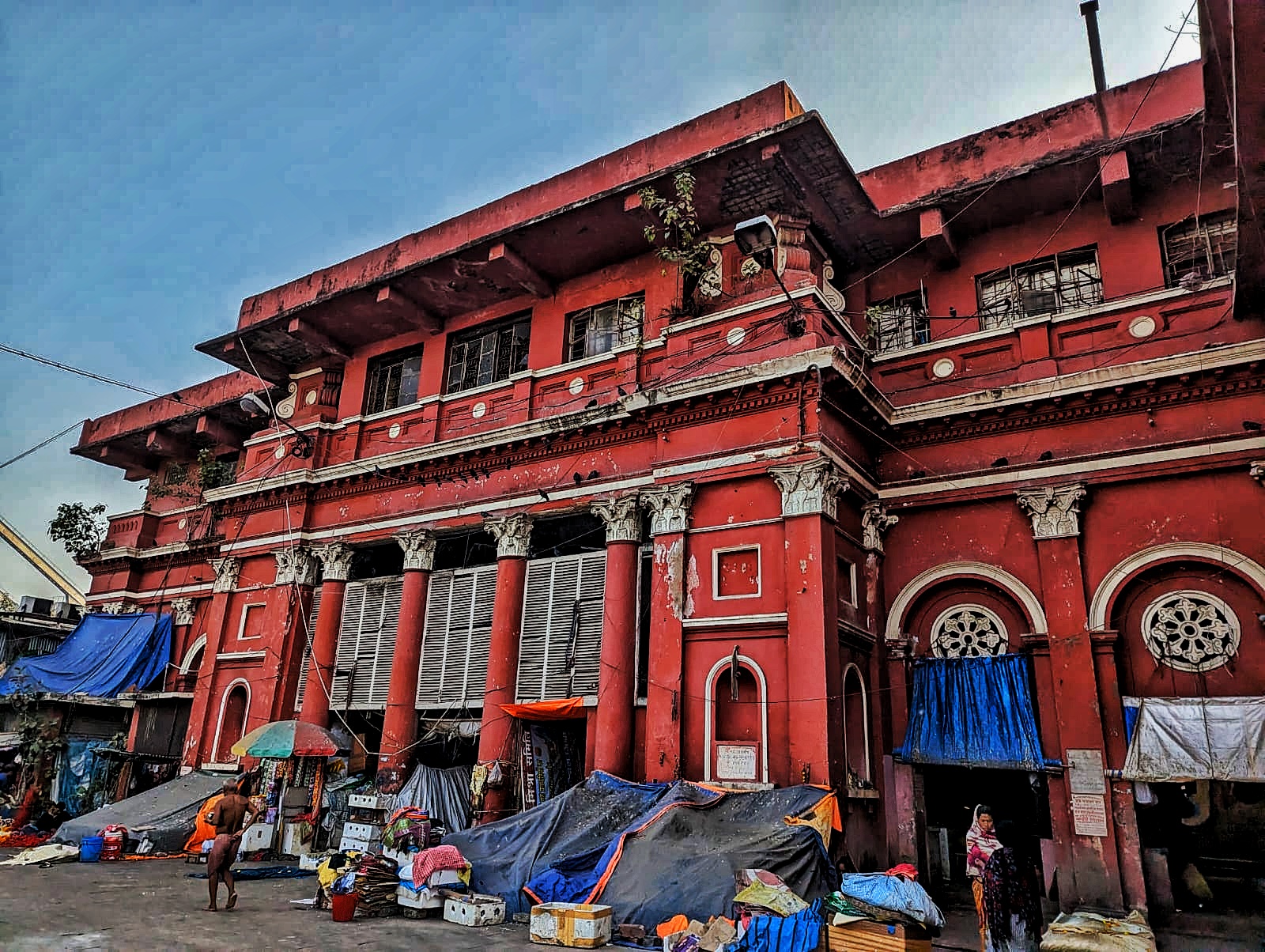
    We began our walk from the Armenian Ghat and the Mutty Seal Ghat. The architecture was indeed grand and spoke of an exuberant yesteryear of grandiosity. But pity that it stands obscure, and daffodils are painted on the walls in the name of revitalisation. Further ahead, the Mullick Ghat, Zenana Ghat, and Prasanna Kumar Tagore Ghat are almost hidden and hard to recognise. It was all to the walk leaders who carefully guided us and pointed to clues to recognise each ghat.

    Revitalization measures ensure that heritage is restored for a suitable use. It also suggests be conservation measures to protect and depict a place’s rich cultural identity. The revitalization also elevates the quality of life. It enhances a place for economic regeneration, safety of users, resilience against risk and sustainable fit for future generations. 

    What meets our eye is different. 

    It wasn’t only that the ghats were obscured from direct view; many websites, articles and local narratives often call these ghats by other names. The Chotulal Ghat is referred to as Mullick Ghat. The Zenana Ghat as a temple (referred to by shopkeepers and locals and read on other websites).The Prasanna Kumar Thakur ghat is converted into living quarters.

    An 1885 image of Chotulal Ghat with its majestic drum like structure on the roof and a white plastered surface. The image is not signed but is believed to be photographed by Johnston & Hoffmann. This image is from an album of 62 views of India and Ceylon. Source: British Library online images
    Chotulal Ghat-A present day image showing its existing condition. Source: Author
    Chotulal Ghat-A present day image showing its existing condition. Source: Author
    The almost obscured Mullick Ghat. Source: Author
    The almost obscure Mullick Ghat showing its condition. Source: Author

    Further ahead, we reached the Nimtala Ghat. It is a Hindu Burning Ghat and holds not only a strong cultural identity but also associational values. The importance of this Ghat lies in its connection to the river. With the river receding over the years, the Nimtala Ghat has shifted three times. The oldest being near the Sree Sree Anandamoi temple. Therefore while the ghats almost appear to be dying, strong cultural beliefs, practices, and larger cultural identities have ensured their survival. 

    Sree Sree Anadamoyee Temple constructed by Nani Mohan Banerjee

    Historic spaces and sites are not assets that we can single out for their uniqueness. Heritage assets exist on connected histories of strong cultural identities evolving constantly and rendering themselves with colours of beautiful memories. The ghats spoke of legacies of generations, business enterprises, and technological advancements.

    They also now reflect the dangers of neglect, improper conservation works, unsuitable revitalisation attempts, confusion amongst stakeholders on what is heritage. The ghats are indeed ‘dying’, and it is summoning all to save them from deranged attempts of losing our cultural identities.

    Now it is up to us to protect, manage, and revive them to their glory.

  • A girl with her morning tea along River Hooghly

    A girl with her morning tea along River Hooghly

    Keyword: Hooghly, Tea, Heritage walk, Kolkata

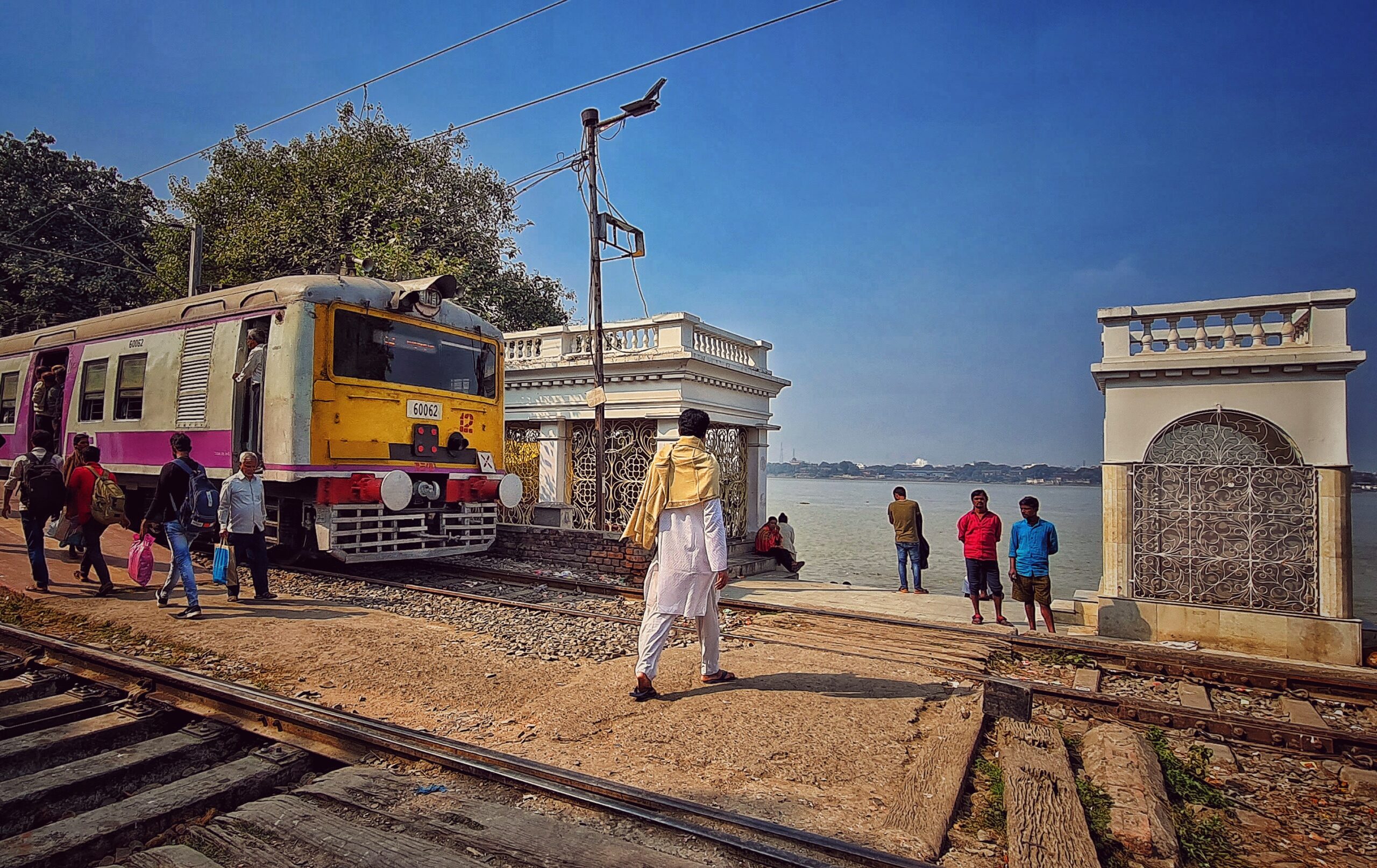
    In Kolkata, May is a hot and humid season. Scorching summer heat cannot allow one to forget the winter air that lightly breezes our face. The freshness of air ruffled hair. The chills in the air are a sign that hot tea needs to be ordered from the roadside kiosk or ‘chaer dokaan’ in Bengali. As my mind drifted away in the Kolkata winter, I could not help but share my early morning walking tryst along the River Hooghly.

    The winter had set in Bengal, and a cool whiff was in the air. Quickly, in an impromptu way, I decided to drive down to the riverbank and relish my morning tea or ‘cha’ by looking at the river. While the city may appear
    chaotic, its soul has not changed much, and one joy is having the ‘cha’.

    As I kept nearing the banks, I slowly rolled the windows down. The ‘City of Joy’ Kolkata from Calcutta has changed considerably. The poetic alleys, the rustic lanes with Art Deco and Neo-classical buildings or as we say, ‘bari’ has become older. These were almost entirely neglected in the newly created garbs of modernism.

    The riverbank is a melting pot with diverse activities. If one conducts diligent Cultural Mapping, it is far from a monologue. The complexity behind the distinctiveness of all activities is mind-boggling. It brings me to a reading from the British Library’s South Hampton to Calcutta’s publication. One of the narrations exuberates the deep connectedness of Calcutta’s people to Hooghly. It brings about a comparative narration of London and Thames, as is Calcutta and Hooghly. This book shares interesting first-count stories about festivals, rituals, daily activities, and many other activities immediately beside the bank.

    One such age-old tradition is the making of ‘bhaar’– the quintessential Bengali earthen clay tea cups. They are made from clay dug out of the riverbed and moulded by potters. The clay is given a delicate shape and baked thoroughly to render an earthy tone to the tea when sipped. Potters have maintained this craft for centuries and here I am sitting with my first cup of tea, sipping from the ‘bhaar’. I kept sipping the tea, looking at steamers transporting passengers across banks. There were early jobseekers soaking at the moment, and tea sellers earning the first trade. All while the city is slowly waking up to the hum-a-droll of the activities around it.

    An Early morning tea sojourn along the river bank

    An Early morning tea sojourn along the river bank. Source Author

  • The River Tales- Story of River Hooghly

    Kolkata, formerly known as Calcutta, is synonymous with the growth history of India. Once the capital of India, it almost set rules of how a growing metropolis with new Urban Planning and Urban Design laws could be. Geographically the city of Calcutta is located East of India along the banks of River Hooghly-Bhagirathi and was a major Trade centre. The imprints can still be seen today.

    River Hooghly, Calcutta by Johnston and Hoffmann, 1885 Source British Library Images

    The River Hooghly was notorious for high silting and often caused ships to get stuck at windings. Travels along the river for work were also getting perilous at a point in time when more Trade grew. The right analogy would be to say a ‘Traffic Jam’ on the river. One of the letters written by Mr Warren Hastings to his wife on August 1780 states that, though he has set sail, the ship is stopped by the wind, tide, and the winding of the river.

    Calcutta and its river banks were too important for driving World Trade by the East India Company; and cannot be deserted. Therefore, began a new approach to Improvement works. The city saw Improvement works to curb sanitation challenges, health challenges, water shortage, land ownership, walkability and many more. From the many, one of them was also ‘Improvement of the River Hooghly Navigation’.

    On 16th June 1865, Mr Leonard, the acting Superintending Engineer of the Public Works Department of Bengal, was appointed for a special task by the Under Secretary of State for India. He was instructed to prepare a report on improving the navigation along River Hooghly. The first report was prepared after extensive data collection from World Rivers. Their improvement works were studied before Mr Leonard could draw up his observations.

    He first travelled to Danube, and understood how silt could be removed at the entrance of the river. Then at Po he learnt documentation process for ground-deepening works. At Berlin he met engineers responsible for technical river works. Then at Danzig he learnt how to examine when a river is excavated, deepened, and connected to the Sea. He also went to the Rhine to understand types of machines that will help remove shoal and regulate the channel. Further on he went to Adour, and found a peculiar approach to river improvement. The ‘bar’ was removed from the river’s entrance. After that, Mr Leonard went to England and met master river engineers Clyde, Wear and Tees, whom he met personally.

    River Hooghly, Calcutta from the Elgin Collection ‘Spring Tours 1894-98’, 1890, Source British Library Images

    As a result of the learnings compiled, River Hooghly Improvement Works were initiated. It accounted for navigation, trade, fresh water supply to homes and networking with the Global Trade centres.

Verified by MonsterInsights